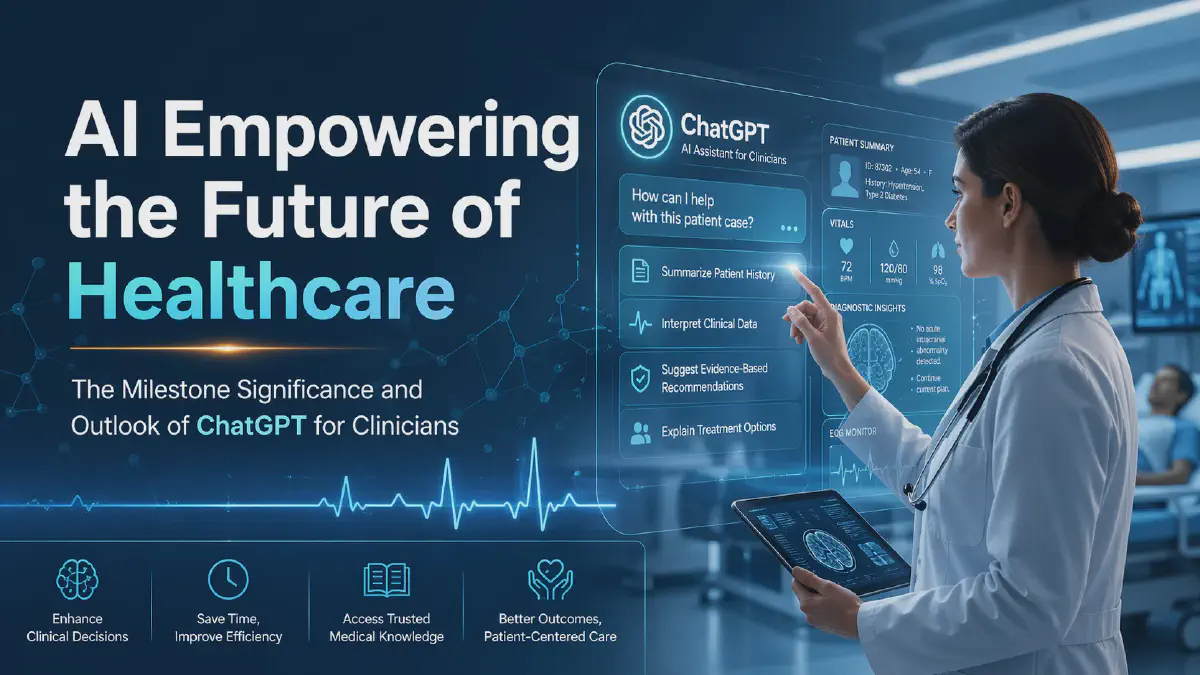
OpenAI recently introduced ChatGPT for Clinicians, a free, dedicated version for verified U.S. clinical professionals, including physicians, nurse practitioners, physician assistants, and pharmacists. It is designed for frontline clinical work such as evidence review, documentation support, and medical research. The product also includes trusted clinical search, citation support, reusable skills, deep research across medical literature, and CME-credit pathways for eligible clinical questions.
This launch marks a concrete shift from general-purpose generative AI to role-specific clinical partnership. It addresses long-standing pain points in care delivery, including administrative overload, rapid evidence growth, and clinician burnout. The core value is not replacing doctors, but augmenting them with a reliable “second brain” for faster, more evidence-grounded, and more personalized decision-making.
1) Why Clinical AI Adoption Is Now Inevitable#
Healthcare systems are under sustained pressure: burnout remains high, documentation consumes hours daily, and millions of new medical papers are published each year. Clinical decisions still need to be made quickly under time constraints. According to 2026 AMA survey reporting, physician AI usage rose from 48% to 72% year over year, showing clear frontline demand for practical AI support.
ChatGPT for Clinicians is aligned with this demand. It offers real-time, citable clinical search over peer-reviewed sources, converts repetitive tasks into reusable skills (such as referral letters, prior authorization, and patient instructions), and accelerates literature synthesis. Publicly shared results also highlight large-scale physician-in-the-loop testing and strong safety/accuracy ratings in real conversations, suggesting that clinical AI is moving from demos to measurable productivity infrastructure.
2) Core Transformation: From Efficiency Gains to System Redesign#
Operational relief for clinicians#
AI can absorb repetitive administrative work, including note drafting, summarization, and coding support, freeing clinician time for direct patient care. As institutional deployment expands, AI scribes and embedded decision support are likely to become standard workflow components.
Evidence-based care and precision pathways#
A combined model of trusted search, deep research, and CME-linked learning can embed current guidelines and literature directly into clinical workflows. AI assistance across multimodal data (imaging, genomics, EHR) may further accelerate personalized treatment planning.
Education, research, and global access#
CME integration is notable because it turns daily clinical questioning into continuous learning. If evidence networks expand geographically, AI could help narrow knowledge-access gaps between high-resource and low-resource care settings.
Human-AI co-working as the default model#
Future care is not “doctor vs machine,” but “doctor + AI.” AI is suited for high-frequency, data-intensive pattern work, while humans remain responsible for empathy, ethics, and final accountability in complex decisions.
3) Risks and Constraints: The Non-Negotiables#
AI in medicine remains a double-edged tool. At least five risk categories require formal governance:
- Hallucination, bias, and safety: citation support does not eliminate edge-case errors or training-data bias.
- Privacy and compliance: PHI handling must remain minimal, auditable, and compliant across HIPAA, GDPR, and local laws.
- Liability and regulation: responsibility boundaries for AI-assisted errors are still evolving across institutions and regulators.
- Equity concerns: if advanced AI remains concentrated in selected systems, access gaps may widen.
- Overreliance risk: clinicians must retain final judgment; AI should remain an evidence-support layer.
OpenAI has published multiple safety measures, including physician red-teaming, multi-factor verification, and commitments around enterprise data handling. Still, the broader ecosystem needs clearer cross-institution governance, transparent auditing standards, and consistent ethical frameworks.
4) Outlook: Building Responsible AI-Native Care#
ChatGPT for Clinicians can be viewed as a maturity milestone for medical AI. It indicates deeper co-creation between frontier AI companies and clinical communities, rather than one-way technology push. Over the next 3-5 years, AI is likely to integrate more deeply into EHR workflows, multidisciplinary care coordination, telehealth, and parts of the drug development lifecycle.
What determines success is not model size alone, but human-centered implementation quality: continuous clinician participation, open benchmarking, cross-border regulatory coordination, and practical training programs.
For healthcare organizations, immediate next steps are actionable:
- establish cross-functional AI governance committees (clinical, legal, IT, ethics);
- start with low-risk, high-repeatability workflow pilots;
- build closed loops for data quality, citation traceability, and outcome measurement;
- integrate clinician training and patient communication into routine rollout.
Final Thoughts#
The real meaning of AI in healthcare is making patient-centered care operational at scale: faster, more accurate, and more accessible. ChatGPT for Clinicians is only a starting point. Sustainable progress will depend on balancing innovation with caution, efficiency with humanity, and technical leadership with equitable access.