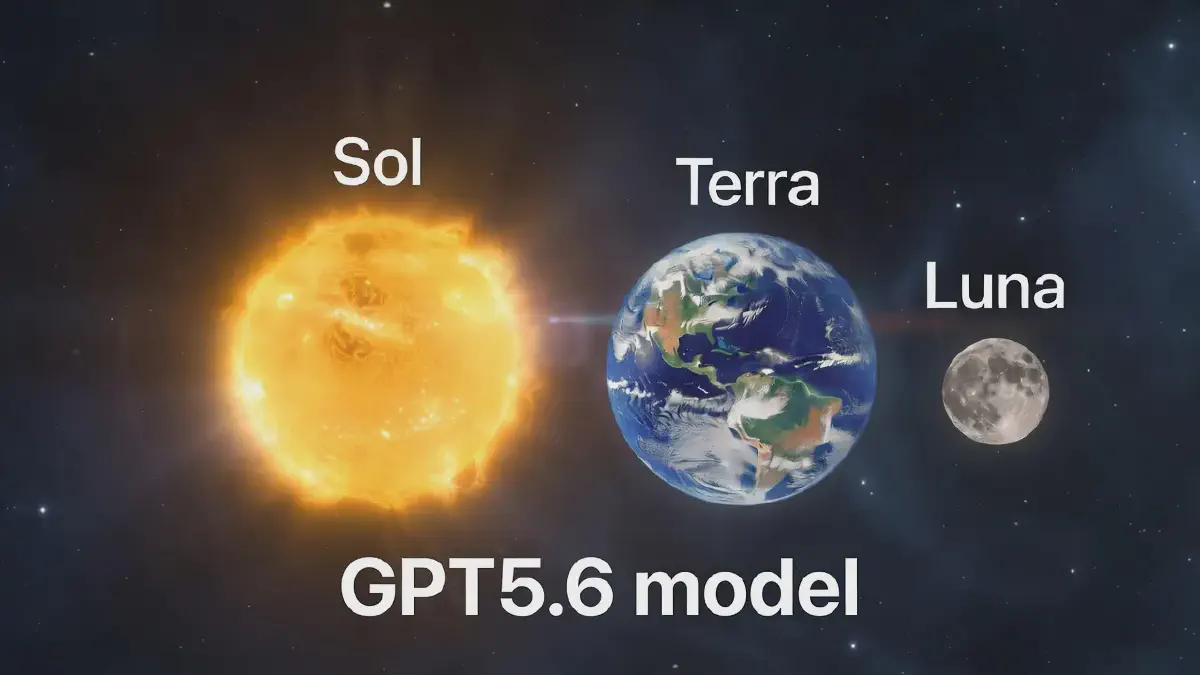
On June 26, 2026, OpenAI officially previewed the GPT-5.6 model family—and introduced something that has been quietly overdue: a proper naming system for capability tiers. Instead of suffixes like “Instant,” “Thinking,” or “Pro,” the new lineup uses three distinct names: Sol (flagship), Terra (balanced), and Luna (fast and affordable).
The announcement came roughly 64 days after GPT-5.5 shipped in April—consistent with OpenAI’s ~40–60-day flagship cadence through 2026. What makes this launch unusual is not the models themselves but the access restriction: at the request of the US government, OpenAI is holding back a broad public release until a national-security review is complete. For now, only about 20 government-vetted trusted partners can access the models via API and Codex.
OpenAI has been direct about not wanting this precedent to stick: the company views the current arrangement as a short-term accommodation, not a template for future releases. A public rollout is expected within weeks.
The new naming system: what Sol, Terra, and Luna mean#
GPT-5.6 formalizes what OpenAI had been approximating with ad-hoc suffixes—a tiered product structure where the generation number (5.6) marks the model family and the name marks the capability tier:
| Model | Positioning | Primary use cases | Cost signal |
|---|---|---|---|
| Sol | Flagship / frontier | Hard reasoning, long-horizon agents, coding, bio, security | Highest (Ultra mode adds more) |
| Terra | Balanced / everyday | Writing, analysis, coding assistance, enterprise workloads | ~half the cost of GPT-5.5 |
| Luna | Fast / cost-efficient | High-throughput, latency-sensitive, cost-capped workloads | Lowest in the family |
The practical implication: if you were running GPT-5.5 for everyday tasks, Terra is the economic upgrade path. If you need maximum capability for complex agentic pipelines, Sol—and especially Sol Ultra—is the target.
Sol’s benchmark results#
GPT-5.6 Sol is OpenAI’s most capable model to date across three areas: coding, cybersecurity, and biology.
Terminal-Bench 2.1 (coding and agent tasks)#
| Model | Score |
|---|---|
| Sol Ultra | 91.9% |
| Sol (base) | 88.8% |
| Claude Mythos 5 | 88.0% |
| GPT-5.5 | 83.4% |
Sol Ultra invokes subagents to parallelize multi-step work—planning, iterating, and coordinating tools simultaneously rather than sequentially. The jump from 88.8% to 91.9% reflects the compounding gains of that parallel execution on complex, open-ended tasks.
Cybersecurity#
Sol achieves competitive scores on ExploitBench while using significantly fewer output tokens than comparable systems—an important signal for defensive security use cases where verbosity is a cost driver. OpenAI has deployed its most robust dual-use safety stack to date for this release: real-time request checks and model-level protections apply specifically to cybersecurity and biology queries.
Biology#
The series improves broadly across SecureBio evaluations, including molecular biology and human-pathogen capability assessments. OpenAI’s public documentation outlines the guardrails applied to high-risk biology queries.
Sol Ultra: subagents running in parallel#
Sol comes with two reasoning depth modes:
- Max reasoning effort: single-model deep analysis for tasks that benefit from careful, linear reasoning.
- Ultra mode: decomposes a complex task into parallel subagent workstreams, then synthesizes results. Think of it as horizontal scaling for a single agent job—useful when time-to-result matters more than sequential depth.
For teams managing large codebase migrations, multi-document legal reviews, or complex security audits, Ultra mode is the closest thing to a self-directed project assistant that OpenAI has shipped.
Caveat: Ultra mode carries higher compute costs and potentially longer end-to-end latency. Official SLA details are expected at general availability.
Why only ~20 partners have access right now#
This is the most consequential part of the GPT-5.6 launch. From OpenAI’s announcement:
At the request of the US government—which has flagged national security implications of frontier AI—this release is launching as a limited preview for a small group of trusted partners.
Approximately 20 organizations, pre-screened and approved, can access Sol, Terra, and Luna via API and Codex. Standard ChatGPT tiers, the public API, and developer sandbox access are all unavailable for now. There is no public waitlist.
OpenAI’s framing matters here: the company cooperated with the request but explicitly stated that government-gated access should not become the long-term default for frontier model releases. The implication is a one-time accommodation under current geopolitical conditions—not a regulatory framework the company intends to normalize.
Broad public release—across ChatGPT paid tiers, the developer API, and enterprise agreements—is expected within weeks.
GPT-5.6 versus GPT-5.5: what actually changed#
| Dimension | GPT-5.5 | GPT-5.6 Sol | Delta |
|---|---|---|---|
| Naming system | Instant / Thinking / Pro suffixes | Sol / Terra / Luna (generation + tier) | New framework |
| Coding benchmark | 83.4% (Terminal-Bench 2.1) | 88.8% base / 91.9% Ultra | +5.4 to +8.5 pct |
| Agentic depth | Tool calling + agent workflows | Ultra mode: parallel subagent execution | Qualitative step up |
| Safety stack | Standard | Dual-use real-time detection + model-level blocks | Most robust to date |
| Launch model | Normal paid-tier rollout | Government-gated limited preview (~20 partners) | Unprecedented |
| Cost profile | Reference tier | Terra ≈ 0.5x GPT-5.5; Luna lower still | Clear step down in mid-tier |
What developers and teams should do now#
If you are one of the ~20 trusted partners: Run your internal evaluation suite against all three tiers before the public launch—you have a meaningful head start.
For everyone else—things to benchmark on day one of public access:
- Terra vs. GPT-5.5 on your actual workload: The ~2x cost reduction claim needs verification against your token distribution and task mix, not just published averages.
- Sol Ultra’s billing model: Subagent parallelism will almost certainly have a distinct token-counting or billing mechanism. Understand it before routing production traffic.
- Safety policy impact on existing prompts: If your workflows touch cybersecurity research, penetration testing tooling, or biology queries, test them against the new safety stack before assuming compatibility.
- Luna’s ceiling: Whether Luna can replace GPT-5.5 mini for high-concurrency workloads depends on its tool-use support and context window—details OpenAI has not yet published.
Routing strategy recommendation: Don’t rely solely on public benchmarks. Run a two-layer eval: Sol for quality ceiling, Terra for cost-performance, Luna for throughput—then route by task class.
The bigger shift: models as rolling infrastructure#
GPT-5.6 is the sixth major version since GPT-5.0 shipped in August 2025—an average of roughly one flagship every 45 days. That pace has structural consequences:
- Annual model selection is no longer viable. Teams that pick a default model and revisit it once a year will persistently run on a version that is one or two generations behind.
- The Sol / Terra / Luna framework is an explicit acknowledgment of this. Rather than forcing users to track suffix changes (Thinking, Pro, mini), OpenAI is trying to create stable tier identities that persist across generations.
- Government involvement signals a new phase for frontier AI. Safety and regulatory posture are no longer just compliance checkboxes—they are now capable of shaping release timelines and access rights for the most capable models.
When the underlying model is upgrading faster than most teams’ planning cycles, the ability to evaluate and switch quickly becomes a competitive advantage in its own right.
FAQ#
When will GPT-5.6 be publicly available?
OpenAI has not named a date, but “coming weeks” is the stated timeline. Watch the OpenAI News page for the general availability announcement.
Is Terra really half the cost of GPT-5.5?
That is OpenAI’s positioning. Actual cost impact depends on your token mix—input-heavy workloads will look different from output-heavy ones. Verify against your own usage before committing.
What is the difference between Sol and Sol Ultra?
Sol Ultra routes the task through multiple parallel subagents and synthesizes their outputs. Terminal-Bench scores jump from 88.8% to 91.9%. Expect higher compute spend and potentially longer latency in exchange for better results on complex multi-step tasks.
Why did the US government get involved?
Sol’s advances in cybersecurity (ExploitBench) and biology (SecureBio) raised dual-use concerns. The government asked OpenAI to allow a security review before broad deployment. OpenAI complied but noted it does not want this to become standard procedure.
What is the context window size for GPT-5.6?
OpenAI has not published official context window figures in the preview announcement. Pre-release leaks suggested 1.5M tokens, but treat that as unverified until official documentation appears at general availability.